Debate with strangers online
Debate with strangers online. Why genuine disagreement, handled well, is one of the best conversations you can have.
Online debate usually means shouting into a void. Real debate, where two people actually listen to each other and try to understand the other's position, is something rarer and more valuable. Here is how to find it.


Text removes tone, adds latency, and rewards performance over understanding.
Comment sections and forum threads look like debate but function more like parallel monologues. Each person is writing to their audience, the people who already agree with them, rather than genuinely engaging with the other person's actual argument. The asynchronous format means you have time to polish your response rather than actually think through the opposing point. And without tone of voice, irony, sincerity, and nuance are all ambiguous in ways that generate heat rather than light.
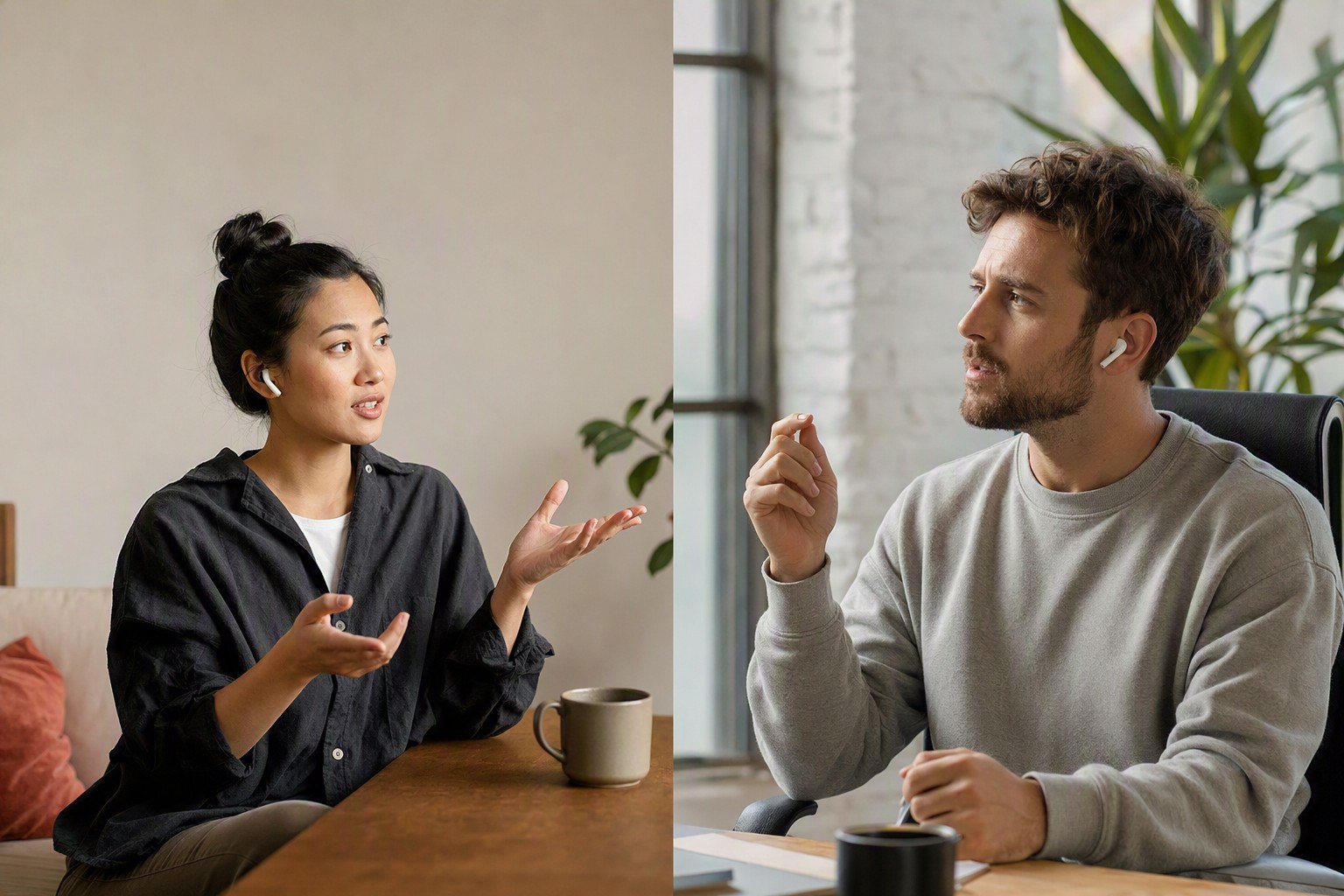
Voice changes this fundamentally. You have to respond in real time, which forces genuine engagement. You can hear when someone makes a point you have not considered and actually acknowledge it. The conversation can move, not just from argument to counter-argument, but somewhere neither person expected.
A stranger from a different cultural context adds another dimension. Their disagreement with you might be coming from a framework you have never encountered. That is a more interesting argument than one from within your own worldview.
A real conversation with someone who might actually disagree with you.
Mindfuse is voice-only, anonymous, and connects you with people from dozens of countries. The format lets real exchange happen, including genuine disagreement that goes somewhere productive. You can argue a point, be challenged on it, and come out of the conversation thinking differently. That is a rare thing.
Two weeks free, then 3 free conversations every week, or upgrade in the app for unlimited. iOS and Android. The best debates start with one tap.
One tap, one random stranger, one live voice conversation.
Here is the whole mechanic. You open Mindfuse and tap one button. The app matches you with a random person somewhere in the world and starts a live voice call with a stranger. No profile, no username, no photo, no video. They hear your voice and nothing else. When the conversation ends, it ends. There is no thread that follows you around, no comment history, no score.
You cannot pick who you get, and for debate that constraint is the feature. When you debate random people online rather than a curated audience, you are guaranteed to leave your bubble. The person on the other end might be a student in Lagos, a retiree in Manila, or an engineer in Berlin. You bring up the topic, they take a side, and the disagreement is real because nothing was pre-filtered to match your views.
The anonymity does the rest. An anonymous debate online has no reputational stakes, so you can actually change your mind mid-conversation, test an argument you are not sure you believe, or concede a point without an audience keeping score. That is the version of debate that text platforms structurally cannot offer.
People searched for a debate Omegle for years. The idea was right, the platform was not.
Some of the best conversations on Omegle were arguments. Two strangers, no shared context, a topic neither expected, and suddenly a genuine debate about religion, politics, or how to live. That is why people still search for an Omegle for debates long after the site shut down in 2023. The random-stranger format is close to ideal for debate: no echo chamber, no reputation, no way to pre-select agreement.
What Omegle got wrong was everything around the format. Free and unmoderated meant that for every stranger willing to argue in good faith, you skipped past dozens who were not there to talk at all. A serious debate needs a counterpart who will stay in the conversation, and Omegle could never guarantee one.
Mindfuse keeps the part worth keeping, random global matching with a total stranger, and fixes the rest: voice only, 18+, and phone verification that filters for people who actually want conversation. If you are comparing the broader field, we ranked the serious apps like Omegle elsewhere on this site. For debate specifically, a filtered voice format beats every video roulette clone, because the person you match with is there to talk, not to perform.
Why an Omegle for debating people works: nothing to perform, nothing to protect.
Every other place you argue online is filtered. Your feed shows you people like you, forums sort into camps, and even debate communities tend to settle on one dominant worldview per thread. Random matching does the one thing none of them can: it hands you a stranger with zero selection, zero shared context, and zero idea what you believe. They were not chosen to agree or disagree with you. They simply hold whatever views their life gave them, often from a country and culture nothing like yours.
Because neither of you has a name, a profile, or a follower count, there is nothing to perform and nothing to protect. No reputation on the line means you can actually be convinced. That is the specific thing people are looking for when they search for an Omegle for debating people: keep the random stranger, lose the chaos.
If you are not sure how to open, try asking straight away: "give me your most controversial opinion". You will find out very quickly whether the debate is on.
Political debate online: argue politics with a stranger who did not grow up in your bubble.
Politics is the debate people search for most, and the one the internet is worst at. Every political space online is pre-sorted: your feed knows your leanings, subreddits have a house position, and group chats agree before anyone types. When people search for an Omegle for political debate, what they are really asking for is an opponent they did not choose, arguing a position no algorithm selected for them.
Random voice matching, call it debate roulette, is the only format that still delivers that. On Mindfuse you tap once and get a live call with a random person from dozens of countries. Bring up immigration, elections, free speech, or whatever is burning in your country this week, and you will often find yourself debating politics with a stranger whose entire political frame was built under a different government, a different media landscape, and a different history. That is a genuinely different argument from another left-versus-right rematch with a compatriot. It is the same mechanic as a voice roulette, pointed at disagreement, and the reason the Omegle-for-debating crowd ended up here.
Anonymity matters most in exactly this arena. Political debate online usually carries reputational stakes: a name, a follower count, a screenshot waiting to happen. An anonymous voice call has none of that, so you can steelman the other side, question your own camp, or change your mind mid-call without anyone keeping score. Calls are not recorded, and when the conversation ends, it ends. For politics, that is not a nice-to-have. It is the only condition under which most people will say what they actually think.
Five habits that turn an argument into a conversation worth having.
Steelman before you counter. Restate their position in its strongest form and ask if you got it right. Half of online debate is people attacking arguments nobody made. Doing this once, out loud, changes the entire tone of the call.
Ask where the belief comes from. With a stranger from another country, the most interesting question is rarely "why are you wrong" but "how did you come to think that". Their answer often reveals a premise you have never had to examine.
Concede the good points immediately. Saying "that is fair, I had not thought of that" costs you nothing when you are anonymous, and it signals that you are debating to understand rather than to win. Strangers mirror it back almost every time.
Separate the claim from the person. You will never see this person again unless you both choose to keep talking. There is no reason to make it personal, and every reason to go hard on the ideas instead.
Know when to switch modes. Some of the best debates dissolve into something else, comparing lives, trading stories, laughing at how differently two people can see one thing. That is not a failed debate. On a random voice chat with a stranger, it is usually the whole point.
Debate with strangers, common questions
Is there an Omegle for debates?
Yes. Mindfuse is the closest thing to an Omegle for debates today. Like Omegle, it matches you with a random stranger anywhere in the world. Unlike Omegle, it is voice only and phone verified, so the person on the other end is actually there to talk, which is exactly what a good debate needs.
Where can I debate strangers online?
Comment sections and forums let you argue with strangers in text, but for a real-time spoken debate you need a live format. Mindfuse connects you by voice with a random person from dozens of countries in one tap. You state a position, they push back, and the conversation goes wherever the disagreement leads.
Can I debate anonymously online?
Yes. Mindfuse keeps you anonymous: no profile, no name, no photo, and no video. The other person only ever hears your voice. That anonymity is what makes honest disagreement possible, because neither of you has a reputation to defend or an audience to perform for.
Can I pick who I debate or choose a topic?
No, and that is the point. Matching is random, so you cannot filter for people who already agree with you. You bring up whatever topic you want once you are connected. The randomness is what produces arguments you have never heard before, from worldviews you have never encountered.
Is voice debate better than text debate?
For genuine exchange, yes. Text debate rewards polished performance for an audience. Voice forces real-time engagement: you hear tone, you have to respond to the actual argument, and you can concede a good point without losing face in front of spectators. Most people find one voice debate more productive than a hundred comment threads.
Is it free to debate random people on Mindfuse?
Yes, to start. Your first two weeks are free and unlimited, no card needed, and after that you get 3 free conversations every week. Unlimited is a paid upgrade in the app, priced for your country, cancel anytime. Every account is verified with a phone number, which keeps the people you match with serious about conversation.
Is there an Omegle for political debate?
Yes. Mindfuse works as an Omegle for political debate: one tap starts an anonymous voice call with a random stranger somewhere in the world, and you bring up the political topic you want to argue. Because matching is global, the other person's politics were usually shaped by a completely different country and system, which makes the debate far more interesting than another round inside your own bubble.
Where can I debate politics with strangers online?
Text platforms let you argue politics in comments, but the threads are sorted into camps before you arrive. To debate politics with strangers who were not pre-selected to agree or disagree with you, use random voice matching: Mindfuse pairs you with a random person from dozens of countries, and the political conversation happens live, by voice, with no audience keeping score.
What happened to Omegle, and why did debaters use it?
Omegle shut down in 2023 after years of moderation problems the platform could not solve. Debaters used it because random matching was the whole appeal: you could not pre-select someone who agreed with you, so every argument came from outside your bubble. Mindfuse carries that format forward by voice, without the chaos.
What is the best Omegle alternative for debate?
For debate specifically, a filtered voice format beats a video roulette clone, because the person you match with is actually there for conversation. Mindfuse is voice only, anonymous and 18+, with phone verification that keeps out bots and drive-by trolls, so your counterpart stays in the argument instead of clicking next.
What is debate roulette?
Debate roulette is random matching applied to argument: instead of choosing an opponent, the platform pairs you with a stranger and the disagreement starts from zero. Mindfuse is the voice version of debate roulette. You cannot pick who you get or what they believe, which is exactly what keeps the debate honest.
A real argument with a real person. Voice, not comments.
Mindfuse: genuine voice debate with people from around the world. Two weeks free, then 3 free conversations every week.