Mindfuse
The anonymous voice chat app for real 1-on-1 conversation.
Mindfuse is an anonymous voice chat app that connects you with a real stranger anywhere in the world, by voice only. No photo, no username, no video, no social profile. Just you and another person, talking. One free conversation a month, then €4/month, cancel anytime.


One free conversation a month, no card needed. Then €4/month, cancel anytime.
People in 80+ countries
Busiest time: the Daily Fuse, every night at 9 PM ET, when everyone comes online together.
Why an anonymous voice chat app works
No social performance
Without a profile to protect, you can say what you actually think. Anonymity creates the conditions for honesty.
Voice is intimate
Research consistently shows that voice carries emotion, warmth, and presence that text cannot. You hear a real person.
No algorithm
Mindfuse doesn't optimise for engagement or time-on-app. You have a conversation. Then it ends. That's it.
No social cost
You don't have to worry about what this person thinks of your life, your looks, or your status. The conversation is the thing.
How the Mindfuse anonymous voice chat app works
Who uses anonymous voice chat?
Mindfuse is used by people who want real conversation without the weight of social media. That includes people who are working from home and miss the ambient social contact of an office. People new to a city who haven't built a network yet. People with intellectual loneliness who want conversations that go somewhere. People awake at 3am who need to talk.
What they share is wanting a real person, not a feed. A conversation, not content.
What people use anonymous voice chat for
Anonymous voice chat is useful for people who want a real conversation without turning it into a public social profile. Some want a quick chat, some want to meet someone new, and others simply find voice easier than text.
People who want a casual conversation
Sometimes you do not need a new friend or a long conversation. You just want to talk to someone for a few minutes. Anonymous voice chat makes that simple: talk about your day, ask a random question, share a funny story, or see where it goes. There is less pressure to keep it going forever. If you both enjoy it, keep talking. If not, you move on.
People who want to talk without a public profile
Not everyone wants to create a public profile before having a conversation. You may not want to upload a photo, collect followers, or explain who you are before talking. Anonymous voice chat removes the social makeup, so the conversation starts with the person, not their profile. That does not mean you should share private information: still decide what you are comfortable revealing.
People who want to meet someone new
It can be a simple way to meet someone from another country you would never meet in everyday life. They could live in another city, another country, or somewhere completely different from your usual circle, and you do not need to know much about them before saying hello. That uncertainty is part of what makes it interesting.
People who prefer voice over text
Some people simply communicate better by talking than typing. Voice gives you tone, pauses, laughter, and hesitation that text cannot fully show, and a short voice conversation can feel more natural than dozens of messages. If you already know you prefer talking to typing, anonymous voice chat is a much better fit than a text-first platform.
Anonymous but safe
Anonymity protects your privacy. It doesn't mean anything goes. Mindfuse has active moderation, community guidelines, and in-call reporting. Conversations that violate the guidelines result in account suspension. Most people on Mindfuse are here for exactly what you're here for: a real conversation.
Here is what protects you in practice, six things, none of them optional:
You stay anonymous
No name, no photo, no profile. You verify with a phone number at sign-up only, it is never shown to the person you talk to. They hear your voice, nothing else.
Nothing is recorded
Calls are not recorded or stored, and nothing is kept about who you spoke to. When the call ends, it is gone.
Voice only, no video
There is no camera and no video option, nothing of you to screenshot, save, or expose.
End it in one tap
You can leave any conversation instantly, no explanation needed. You are never stuck.
Real moderation
Every user agrees to community guidelines, there is in-call reporting, and breaking the rules means suspension.
The €4 is the filter
The single biggest safety feature is the small subscription: it removes the bots and throwaway accounts that flooded the free platforms. You are talking to people who chose to be there.
What anonymous actually means
Anonymous does not have to mean completely unprotected. A good anonymous voice chat app should reduce unnecessary identity exposure while still giving people tools to deal with harmful behaviour.
What anonymous means
Anonymous means you do not have to make your real-world identity the centre of the conversation. You can talk without showing your public profile, real name, or the information you would normally share on social platforms. It does not mean complete invisibility: some platforms still process technical information needed to run the service, and the other person may learn something about you from what you say.
Privacy without giving up safety
The best experience is not simply "nobody knows who you are." It is being able to control what you share while still having ways to deal with bad behaviour. A safe platform should make it easy to leave a conversation, and give you clear ways to block or report another user. You should not have to reveal your identity just to have basic control over a conversation.
What to look for in a safe anonymous voice chat app
Before choosing a safe anonymous voice chat app, check for these basics:
- Clear privacy policy: know what the service collects and why.
- Microphone controls: the app should clearly request access, not hide it.
- Block and report tools to stop unwanted contact quickly.
- A simple exit: leaving a conversation should not require an explanation.
- Moderation, with rules against harassment and abuse.
- Age rules: check who the service is designed for.
- No unnecessary profile exposure.
- Clear data practices: know whether calls or other information are stored.
These details matter because privacy is not only about what an app promises. It is about what it actually collects, stores, and lets you control.
Is Mindfuse really anonymous?
Yes. The person you talk to never sees your photo, your name, your location, or any social profile. You don't see theirs. After the call ends, there's no chat history, no follow request, no way to find each other again unless you both choose to share something. That is what anonymous voice chat means here, not a username behind a mask, but no identity at all. For a closer look at what that protects in practice, see how anonymous calls work.
Anonymous voice chat vs anonymous text chat
Anonymous text chat is the older format, Omegle, message boards, anonymous DMs. It's quick to start but easy to disengage from, and the lack of voice makes it harder to feel like you're talking to a person. Anonymous voice chat keeps the privacy of text but adds the warmth of a real human voice. You can hear tone, hesitation, laughter. The conversation goes somewhere because it has to. If being matched with someone new each time is the part you want, that is exactly how random voice chat works on Mindfuse.
Anonymous voice chat vs text chat, at a glance
| Anonymous voice chat | Text chat | |
|---|---|---|
| How you connect | You talk naturally in real time using your voice. | You communicate by typing messages. |
| Privacy | You keep your identity private while focusing on the conversation. | Text can be tied to a username, profile, or chat history. |
| How personal it feels | Tone, laughter, and pauses make it feel more human. | You depend on written words and emojis to read someone. |
| How quickly you connect | A few minutes of talking reveals personality quickly. | It takes more messages and time to get the same sense. |
| Social pressure | No profile photos or posts to think about. | Profiles, typing, and carefully written replies. |
| Best for | Real conversations, meeting strangers, hearing new perspectives. | Sharing information and slower conversations. |
| Main trade-off | You need to be comfortable speaking and giving your attention. | Less immediate and personal, but easier to step away from. |
If you want to...
| Have a private, one-to-one conversation | Anonymous voice chat |
| Meet someone from another country | Global voice conversation |
| Practise speaking a new language | Language exchange |
| Hear how people actually live in another culture | Talk to someone from that country |
| Join a discussion with several people | Group voice communities |
| Share something personal without knowing someone socially | Anonymous conversation |
| Get help for a serious mental-health crisis | A qualified professional or crisis service |
| Simply message someone when you cannot speak | Text chat |
What makes the best anonymous voice chat app
A good anonymous voice chat app makes conversation easy without making you give up control over your privacy. The best experience is not just finding another person, it is making the conversation feel natural, private, and easy to leave.
Real people, not bots
A conversation is only useful if the person on the other side is real. Many people prefer voice because they want the unpredictability of a real conversation, and scripted or AI responses cannot replace the small things that make one interesting.
One-to-one conversations
One-to-one voice keeps the conversation focused on two people. You do not compete with a room full of speakers or wait for someone to notice you. Both people have space to speak, listen, and change the subject, and it feels less intimidating than speaking to a group.
Clear privacy controls
You should know what you are sharing, what permissions the app needs, and what happens to your data. If the privacy explanation is hard to understand, that is a reason to slow down and check before continuing.
Simple matching
The best matching gets you into a conversation without making it feel like work. You should not spend ten minutes building a profile before finding someone. The goal is conversation, not profile building.
Safety and reporting
Every platform that connects strangers needs a way to handle bad behaviour. Look for clear block and report options, and the ability to leave an uncomfortable conversation immediately. Safety tools do not ruin the spontaneity, they give you more control when something goes wrong.
Free vs paid anonymous voice chat apps
Free and paid apps can both be useful. The better choice depends on what you value most, because price alone does not tell you whether a platform is private, safe, or enjoyable.
| What to compare | Free | Paid |
|---|---|---|
| Cost | Usually no subscription | Usually a subscription or paid feature |
| Getting started | Often built for quick access | May include more account or payment steps |
| Matching | Basic random matching | May add matching or filtering features |
| Privacy | Depends entirely on the platform | Payment does not automatically mean better privacy |
| Safety | Check blocking, reporting, moderation | Check the same, do not assume it is better |
| Advertising | Some rely on ads | May reduce or avoid ads |
| Best for | Trying the experience without paying | People who value specific paid features |
The point is simple: free does not automatically mean unsafe, and paid does not automatically mean private. On Mindfuse the small fee is the filter, it is what keeps out the bots and throwaway accounts.
Browser vs app: what actually matters
Choosing between a browser and a native app is mostly about convenience and permissions. Neither is automatically more private. A browser is handy when you want to start without installing anything, which is useful the first time you try a platform. A native app tends to give a smoother mobile experience when voice conversations are something you use regularly. Either way, the question is the same: what does the service collect, why does it need it, and what control do you have over it?
More than random conversations
Anonymous voice chat is not only about meeting a random stranger. The same format works when you want to practise speaking, hear how life feels somewhere else, or simply talk to someone anonymously when your usual contacts are unavailable.
Practising a language with a real speaker
Speaking with a real person exposes you to normal pronunciation, pauses, slang, and the way people actually speak, and you have to respond instead of recognising words on a page. That makes it useful for practising a language naturally.
Talking when friends are unavailable
Sometimes you just want another human voice. Your friends are busy, your family is asleep, or you would rather not bring a topic to someone you know. An anonymous conversation is a low-pressure way to talk without turning it into a long-term relationship.
How anonymous voice chat privacy works
Anonymous voice chat is not a magic privacy button. The real privacy experience depends on what a platform collects, what it stores, what it shares, and what the other person can learn from the conversation. Our guide to anonymous voice calls explains this in more detail.
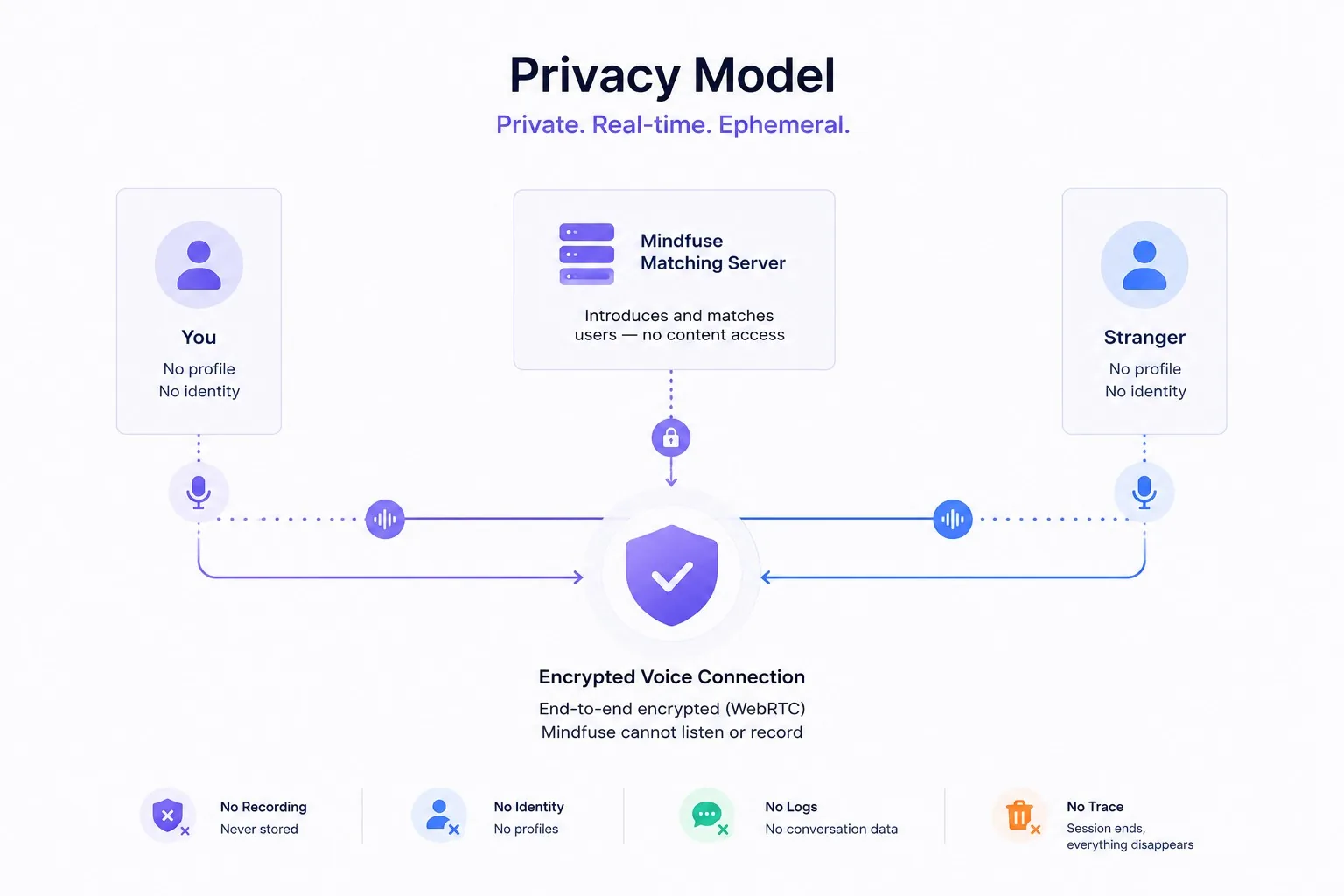
The simplest way to understand privacy is to ask four questions: what does the platform collect, why does it collect it, how long does it keep it, and who can access it? Those are more useful than simply asking whether an app is "anonymous." And even on an anonymous service, telling someone your full name, workplace, or address makes you much easier to identify, so decide what you reveal.
1-on-1 voice vs group audio
One-to-one voice and group audio are built for different experiences. Group audio puts you in a room with several people: you listen, speak when you get the chance, and it works for communities, events, and live discussions. One-to-one voice is simpler, there are only two people, so the conversation does not compete with a room, and there is no audience effect to manage. Choose group audio when you want a community or multiple opinions. Choose one-to-one voice when you want a private, direct, more personal conversation. Neither is universally better, they solve different problems.
When anonymous voice chat is and isn't the right tool
Anonymous voice chat works best for ordinary human connection: casual conversation, meeting someone new, or talking through everyday thoughts. It is not a replacement for professional or emergency support.
Everyday conversation and connection
If you just want to talk, it is a good option. You might be bored, curious about another country, interested in practising a language, or simply in the mood for a conversation with someone new.
When you just need someone to listen
Sometimes you do not want advice, you just want to say what is on your mind. A conversation with another person can help you organise your thoughts or feel less stuck, and an anonymous setting can feel easier when it is something you would not raise with people you know.
When professional or crisis support is more appropriate
Anonymous voice chat is not a replacement for therapy, medical care, or crisis support. If someone is dealing with immediate danger, thoughts of self-harm, abuse, or another serious crisis, a random conversation is not the right level of support, use an appropriate professional or crisis service in your area.
Anonymous voice chat app: common questions
Do I need an account or profile to use an anonymous voice chat app?
On Mindfuse there is no profile, no username, and no photo. You verify once with a phone number to prove you are a real person, it is never shown to anyone you talk to, and it is the reason the matches are humans instead of bots. To the people you meet, you are only a voice.
Is anonymous voice chat safe?
Safer than most formats. It is voice-only, so there is nothing of you to screenshot or record. Calls are not stored, moderation is active with in-call reporting, and you can end any conversation in one tap. The small subscription filters out the bots and throwaway accounts that made free anonymous platforms dangerous.
Is Mindfuse free?
Your first conversation each month is free, no card needed. Want unlimited calls? It is €4/month, cancel anytime. The fee is deliberately small, and it is the main thing keeping the community real.
Can the other person find me after the call?
No. No numbers are exchanged, no profiles exist, and nothing is kept about who you spoke to. When the call ends, there is no thread back to you unless you both chose to share something during the conversation.
Can I stay anonymous if I have to verify with a phone number?
Yes. Verification and anonymity are separate things: the number proves to Mindfuse that you are a real person, once, at sign-up. It is never displayed, shared, or visible to the people you talk to. They hear your voice and nothing else.
What happens if someone breaks the rules?
Every user agrees to the community guidelines, and there is reporting inside the call itself. Breaking the rules means suspension. Because accounts are verified and paid, getting banned actually costs something, which is why bad behaviour is rare compared to free platforms.
Is anonymous voice chat better than text chat?
Anonymous voice chat can feel more personal than text because you hear tone, pauses, laughter, and emotion instead of only reading words. Text is better when you need time to think or want a written record, while voice works well when you want a conversation that feels more natural.
Can I use an anonymous voice chat app without showing my identity?
Yes. Some apps let you talk without showing your name, photo, username, or public profile. On Mindfuse your phone number is used for verification but is not shown to the person you are matched with, so they know you through the conversation rather than a profile.
Can I talk to strangers anonymously?
Yes. Anonymous voice chat apps match you with people you do not already know. Mindfuse is built around this one-to-one format, so you can meet someone new and have a real voice conversation without exchanging personal contact details just to start talking.
Can I use voice chat without showing my ID?
Some anonymous voice chat services let you start without showing your identity to the person you are talking to. Mindfuse uses one-time phone verification to make sure accounts belong to real people, but your number is not shown to the person you are matched with, so you stay anonymous to other users without using an unverified account.
€4/month, cancel anytime
No ads. No data selling. A simple subscription that keeps the lights on and the community healthy.
Talk to a real stranger, anonymously.
Voice only, no profile, no record. One free conversation a month, no card needed. Then €4/month, cancel anytime.
Busiest time: the Daily Fuse, every night at 9 PM ET, when everyone comes online together.

Scan to get Mindfuse
Related